A System That Does Not Deliver
Across the world, momentum in the creative economy is expanding. Policies are being developed, frameworks adopted, and ambitions clearly articulated. Yet outcomes remain limited.
In many contexts, the foundations already exist: cultural policy, trade frameworks, IP systems, and investment instruments. The intent to support the cultural and creative sectors is clear. But intent is not performance.
What we see instead is a consistent pattern: fragmented implementation, weak coordination, and limited translation of policy into practice. Creative enterprises struggle to scale, IP systems underperform, and trade and investment opportunities remain largely underutilised.
The instinctive response is often to refine policy, revise frameworks, or produce new strategies. But this misses the core issue. The challenge is not policy. It is delivery.
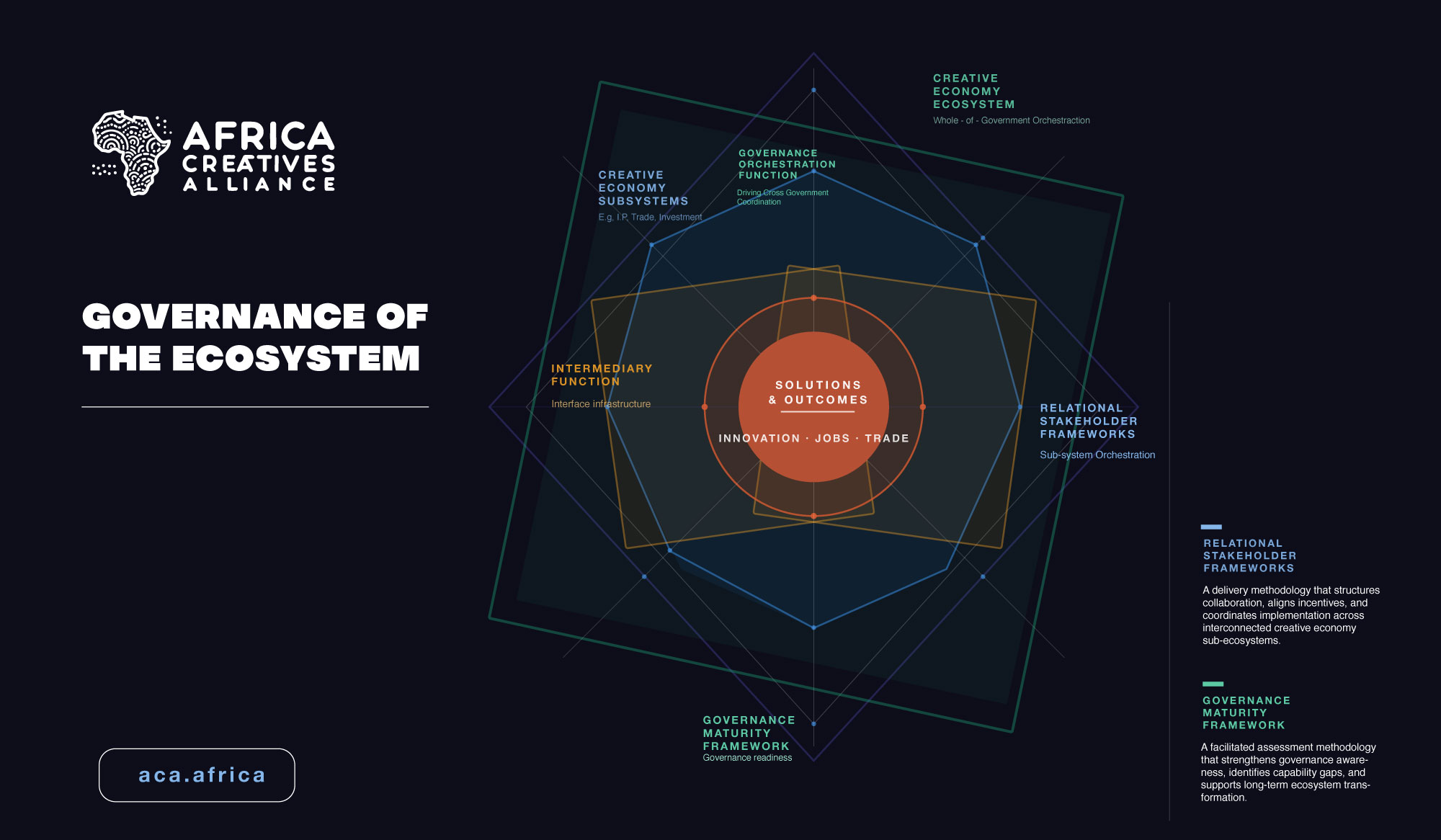
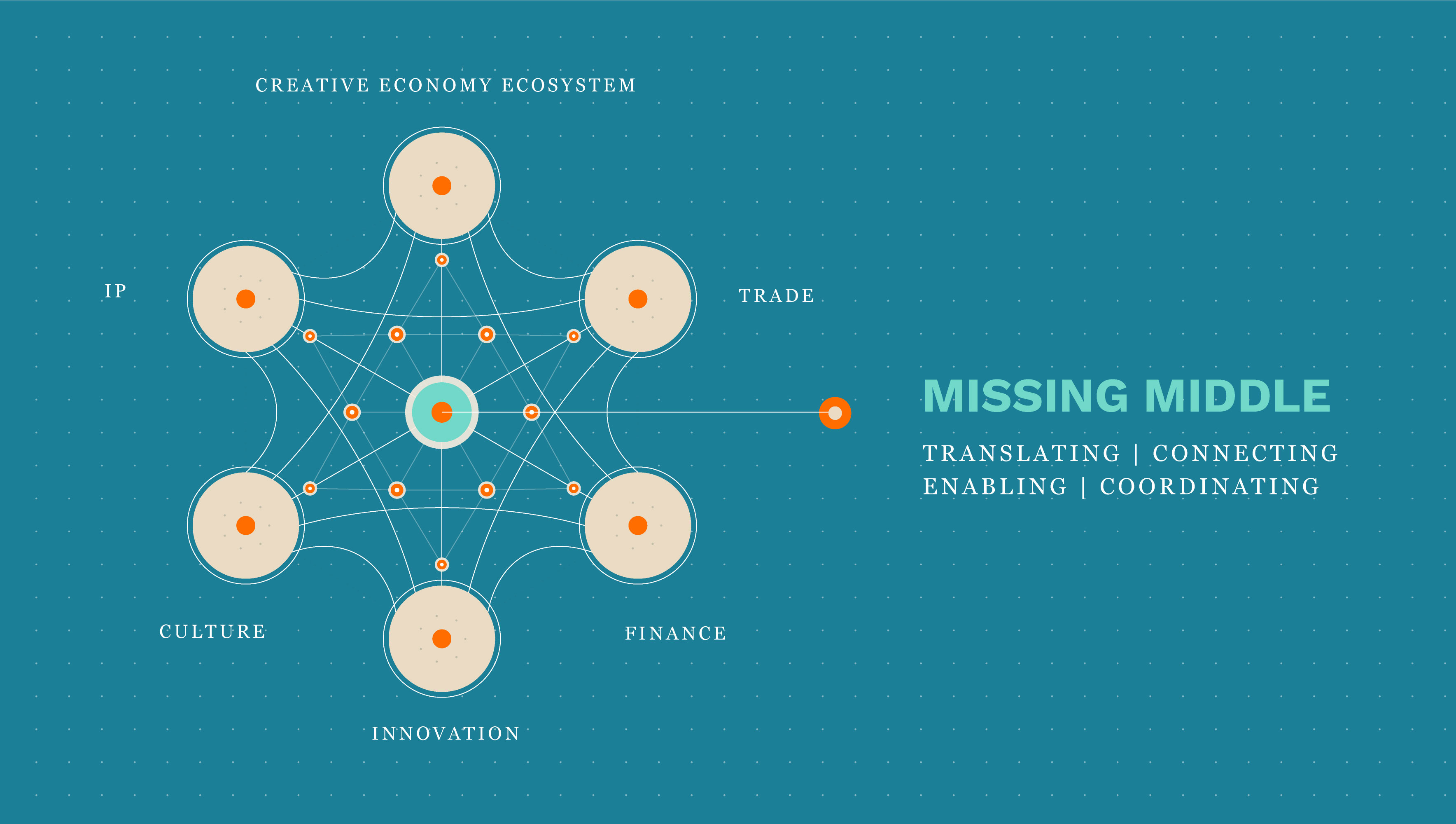
Creative economy governance spans multiple domains, including culture, trade, finance, innovation, and education. Yet these rarely function as a coherent system. Policies define direction. Institutions hold mandates. Funding enables activity. But none of these, on their own, ensure that the system works. What is missing is the layer that connects them.
Between ambition and impact lies a gap where coordination breaks down, roles remain unclear, and value struggles to circulate across the ecosystem. Until this layer is addressed, creative economy strategies will continue to produce isolated successes rather than systemic outcomes.
The Blind Spot
Governance discussions tend to focus on what is visible: ministries, laws, and funding. But they rarely address how the system actually functions. This is the blind spot.
In many contexts, the issue is not the absence of policies or strategies. It is the absence of mechanisms that connect them and enable them to work together. Mandates are fragmented, frameworks operate in parallel, and stakeholders rarely interact in structured ways.
The system appears complete on paper, yet fails to function in practice. What is missing is not another layer of policy, but the relational infrastructure that enables coordination, alignment, and delivery.
Intermediaries as System Infrastructure
If the issue is how systems function, the question becomes: who makes the system work?
Intermediaries include ecosystem builders such as hubs, makerspaces, incubators, accelerators, industry associations, and other coordinating entities operating between creators, markets, institutions, and policy systems.
They are often framed as support actors or service providers positioned at the margins of the ecosystem. But this framing is too limited.
In reality, intermediaries already perform functions that are central to system performance. They translate policy into practice, connect actors across silos, enable access to markets, finance, and networks, and structure participation and collaboration across fragmented ecosystems.
Seen from this perspective, intermediaries are not peripheral actors. They are the operational infrastructure through which creative economy systems coordinate, circulate value, and translate policy into market outcomes.
What Intermediaries See That Others Don’t
If intermediaries are the connective layer of the ecosystem, their role becomes visible in what they enable.
When recognised and capacitated, they drive two critical outcomes:
• capability building by strengthening enterprises and ecosystem actors
• market activation by enabling access to trade, investment, and IP monetisation
But their role goes further.
Because intermediaries operate simultaneously across policy, markets, institutions, and creative communities, they occupy a uniquely strategic position. Operating between systems rather than within a single mandate, they experience the ecosystem as a whole.
They do not encounter isolated challenges. They see recurring systemic patterns: where coordination fails, where value stalls, and where frameworks break down in practice. This gives them a form of system intelligence: theability to identify structural failures across cases, not just individual constraints.
This is why their absence becomes consequential.
Without a strong intermediary layer, policies remain declarative rather than operational. IP systems struggle to translate ownership into economic value. Trade and investment frameworks fail to reach creative enterprises in meaningful ways. Ecosystems become fragmented, reactive, and difficult to scale.
What is often interpreted as policy failure is, more accurately, a failure of coordination, orchestration, and delivery.
Intermediaries create feedback loops between policy and practice, structure participation, enable collaboration, and build networks and value chains across the ecosystem. It is precisely this between-systems position that makes them central to the operational layer through which the creative economy moves from intention to performance.
The Shift: Integrating the Missing Layer
If intermediaries are central to how creative economy systems function, they must be treated as part of the infrastructure of delivery.
This requires:
• formal recognition within governance systems
• integration into trade, IP, and investment frameworks
• development of operational standards and mandates
• long-term institutional and financial support
Looking Forward
If the missing layer of creative economy governance lies in how systems are connected and activated, then the challenge is no longer simply to define the creative economy, but to make it work.
This requires moving towards structured delivery systems, where roles, relationships, and coordination mechanisms are made explicit across the ecosystem.
The forthcoming Africa Creatives Alliance Pathways for Creative Economy Delivery, authored by Johanna Kouzmine-Karavaïeff, builds on this premise. It addresses not only the role of intermediaries, but also the wider governance and institutional architecture, alongside the core systems of IP, trade, and investment that remain underdeveloped in many contexts. Its focus is on how these elements can be aligned and operationalised through relational frameworks that enable coordinated action.
Because ultimately, the future of the creative economy will be determined not by ambition or policy design, but by the ability to translate both into functioning systems.

Johanna Kouzmine-Karavaïeff
Director, Research and Creative Economy Systems
Africa Creatives Alliance

Rita Ngenzi
Founding Executive Director
Africa Creatives Alliance