
Beyond Creative Economy Policy:
Building the Delivery Systems for Implementation
Why policy ambition is not enough, and what it takes to move from strategy to delivery
Across Africa and globally, the creative economy is gaining unprecedented policy attention. Governments are developing strategies, legislation and programmes. Creative industries are increasingly recognised for their contribution to employment, trade, innovation, cultural value and economic diversification.
Yet a persistent question remains: why does growing policy ambition so often fail to translate into implementation at the scale expected?
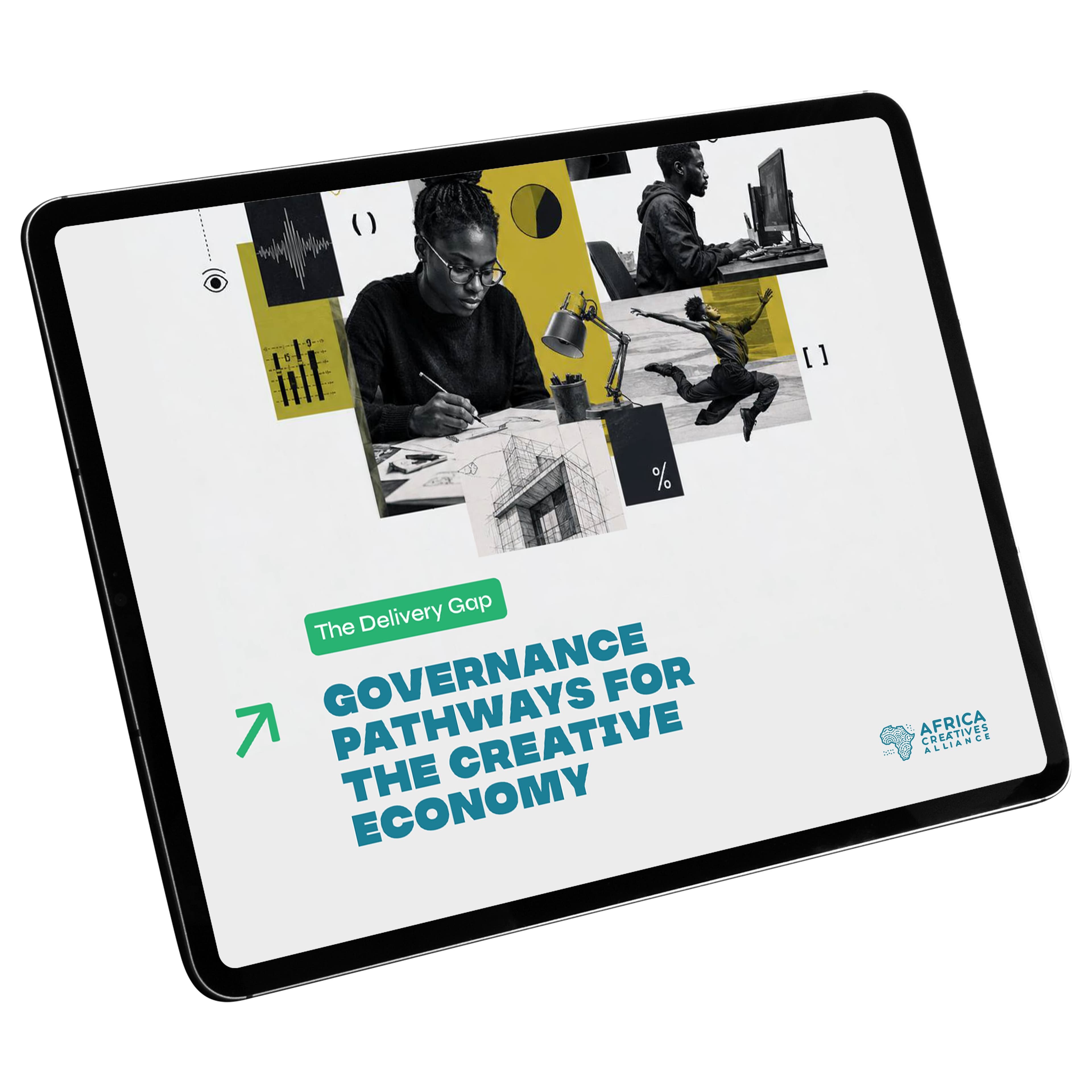
The Delivery Gap: Governance Pathways for the Creative Economy, a new publication by Johanna Kouzmine-Karavaïeff, Director Research & Creative Economy Systems, Africa Creatives Alliance, argues that the next challenge for the creative economy is no longer simply to develop better policies. It is to build the governance and delivery systems capable of making them work.
The publication approaches the creative economy as a system of systems spanning culture, trade, intellectual property, investment and finance, enterprise development, education, innovation and other policy domains. Its performance therefore depends not only on the strength of individual institutions or policies, but on how effectively they connect, coordinate and deliver together. It also highlights the often-under-recognised role of intermediary organisations as part of the infrastructure connecting policy, markets and creative communities.
But is this really a challenge specific to the creative economy?
This launch webinar used The Delivery Gap as the starting point for a wider conversation about implementation, institutional capacity and coordination across complex policy systems. Bringing together perspectives from government, the World Bank, African capacity-building expertise and research on sustainable tourism systems, the discussion examined a shared challenge: what happens between policy ambition and actual delivery?
Rather than another conversation about the potential of the creative economy, the webinar asked practical questions about what it takes to realise that potential.
- Where does implementation break down?
- Who coordinates when responsibility crosses several ministries and institutions?
- How can trade, enterprise development, investment and other existing systems better connect with cultural and creative sectors?
- What functions do intermediaries perform between government, markets and practitioners?
- And what can the creative economy learn from other transversal fields facing similar coordination challenges?
These questions are particularly timely because the implementation problem is not unique to the creative economy. The Delivery Gap draws connections with sustainable tourism, innovation and industrial policy, sustainable development and other complex policy domains where governments are similarly confronting the limitations of siloed institutional structures and the need for more adaptive, collaborative forms of governance.
The webinar also introduced emerging pathways explored in the publication for strengthening the governance and delivery architecture of the creative economy. This includes the need for stronger whole-of-government coordination, alongside intermediary functions that connect public institutions with markets, creative enterprises and ecosystem actors and help orchestrate delivery within specific sub-systems such as trade, intellectual property and investment.
The publication explores how these functions can be strengthened through complementary governance and delivery methodologies—helping governments and ecosystem actors better understand governance readiness, identify systemic bottlenecks, and structure the relationships and coordination mechanisms required for implementation. Early validation work in Kigali in 2025 suggests that some implementation barriers can be addressed not through another strategy, but by strengthening how institutions, intermediaries and market actors work together around shared delivery challenges.
If the policies and strategies increasingly exist, are the systems required to deliver them in place?
Ultimately, the conversation asks a different question about the future of the creative economy.
Contributors

Johanna Kouzmine-Karavaïeff
Director, Research and Creative Economy Systems
Africa Creatives Alliance

Dr Joshua Mutambi
Commissioner, Processing & Marketing
Ministry of Trade, Industries and Cooperatives

Vara Vemuru
Practice Manager for Social Policy
World Bank

Abdrahamane Dicko
Director of Programs & Impact
The African Capacity Building Foundation

Suzanne Duffour
Implementation Intelligence Researcher
Founder, YUN Consultancy
The launch of The Delivery Gap is therefore not intended as the conclusion of a research process. It is an invitation to governments, development partners, international agencies, intermediaries, researchers and creative-economy actors to begin building a stronger field of practice around Creative Economy Governance and Delivery.
Read The Delivery Gap
Governance Pathways for the Creative Economy — the full publication is available to download.